Sunday, October 08, 2023

Are your 'loyal employees' lying to you?


According to People Management, 60% of employees are actively looking for work. Let that number sink in. 

How about in your company? Frank, your best salesperson, who ‘loves your company’. Is he interviewing at three other companies right this minute? How about Sally, who ‘couldn’t work anywhere else’ and is your 'client onboarding ninja'? Is she really with you? Or is she ‘Open for work’ to recruiters on LinkedIn? 

John, your network engineer, sure, he is slow, but he's talented, and besides, it's so hard to hire good engineers!

- Turns out the reason he's so slow is because he's moonlighting at your competitor's company, as a contractor (fully remote, of course!). That's one way to crack the cost of living crisis! 

Employee loyalty has been diminishing for years now. Covid and the cost of living crisis have accelerated that trend - anyone in talent acquisition or recruiting will tell you that most employers are vastly over-optimistic in their assessment of their own employee's loyalty levels. Many employers are living in a fool's paradise - and soon, reality will bite.

Times are tough – interest rates are rising, making those once easy-to-pay mortgage payments almost unbearable—everything has gone up in price, except for salaries, which have flatlined. 

Employees are not getting raises because usually their company cannot afford them – until it’s too late. Then their companies must pay the new salary, which is often 5%, 10% or even 20% above the old one.

What can an HR leader do to alleviate this situation? Particularly with 2024 around the corner. And you know what that means, right? 

Your employees could barely afford their Christmas last year. This year, they know it'll be even worse. They feel stressed, overworked, under-appreciated, and underpaid. And now they have some New Year’s resolutions:

  • Join a gym.
  • Go on a diet.

The last few years have been tough for HR Heads. First Brexit (in the UK), then the pandemic, then quiet quitting, the great resignation, and even loud quitting. How can Human Resources leaders calm those evil thoughts and sleep tight into 2024?

Another side-effect of having so many employees actively searching for better roles, is that even when at work, they are disengaged and unproductive. This is one reason why the UK,  and many other countries have experienced stagnating productivity over the last fifteen years.

I recently attended ‘Employee Benefits Live’, and one message came across clearly: The importance of collecting and harnessing your data. Not only to develop insights to make your decision-making more effective but also, to communicate better with your Executive Board, your CEO and your CFO.

    The keynote at Employee Benefits Live, in London, UK, on Oct 3rd, 2023

Have you ever had a brilliant idea that you were sure would make an enormous positive difference in your company? An initiative you were sure would build trust, engagement and loyalty in your employees? Or even help to acquire more talent? 

- Only for it to be shot down immediately by your CFO?

  • CFOs don’t care about your ‘great ideas'
  • They need data and numbers. And ultimately, they only care about the money. NOTHING ELSE MATTERS to them except the return on investment. 
  • Many HR Leaders still use data ineffectively. Some even need help to understand their own data.
  • If you can't speak the language of the C Suite and CFO, (Numbers and metrics), the programs you believe in will not progress past the idea stage.

Mastering and using your data more effectively is one way to step up your game and bring important initiatives to your company; 

Getting those vital programs off the ground, you know, will be critical to ensure fewer of your company's employees are ‘actively seeking a new role right now’.

Saturday, August 19, 2023

What is marketing strategy?

Marketing strategy comes up regularly as a topic at B2B Startups. However, often it is confused with operational effectiveness. 

Operational effectiveness Is Not Strategy.

The root of the problem in answering the question of 'What is marketing strategy?' is the need for more clarity in distinguishing between operational effectiveness and strategy.

Of course, companies must be flexible to respond rapidly to competitive and market changes. They must benchmark continuously to achieve best practices.

Marketing has more platforms, ways to measure, and analytics benchmarks than ever. Although the resulting operational improvements have often been dramatic, many companies have been frustrated by their inability to translate those gains into sustainable marketing profitability. 

Despite improvements in all aspects of marketing technology, hitting the right metrics like cost per click, cost per impression, cost per lead, opportunity, and, of course, return on investment of marketing campaigns (ROMI) continues to be a challenge. 

‘A rising tide lifts all boats’

When everyone benefits from these incremental operational improvements – anything from better buyer intent data, to a clearer understanding of which marketing channels, campaigns, and ads drive the best results (Marketing ROI or ROAS), by the same logic, no one benefits.

That is too stark an option since, yes, some companies are in the top 5% of utilizing the latest marketing technology the most effectively and naturally, they will benefit relative to the competition. But the problem is that those methods can be duplicated.

Yet many B2B Startups don't want to admit that their often bigger, wealthier competitors may have a strong edge—a bigger brand and deeper pockets than them.

In my 20 years in Marketing, in some companies I've worked at, no one, even in the marketing department, had a clear idea of the marketing strategy, nor could they articulate it.

Occasionally this topic comes up profoundly. For example, about ten years ago, the CMO of a fast-growing and successful cybersecurity software company I worked for wanted to move away from marketing focused on lead generation, to almost exclusively on branding. 

Eventually, the will of the CEO prevailed; the CMO left, and the company shifted back from branding to a heavier investment in lead generation. 

For a B2B Startup, what's more important - Branding or Demand Generation (Activation)? Turns out the CEO was right. According to research, creating new customers early is more important than creating a brand. 

Your brand will develop from your customers and your employees. That's no doubt why that start-up is now a $30 billion market cap listed company on the Nasdaq. Of course, once you have a solid roster of customers, that is the ideal time to focus on the brand.

Operational effectiveness and strategy are both essential to superior performance. However, a company can only outperform its rivals sustainably in the long term if it has a superior marketing strategy.

Operational effectiveness means performing similar activities better than rivals. Another reason that improved operational effectiveness is insufficient—competitive convergence—is more subtle and insidious. The more benchmarking companies do, the more they look alike.

So what exactly is a Marketing Strategy for a Business to Business company?

A business-to-business (B2B) marketing strategy is a comprehensive plan designed to promote and sell products or services from one business to another. This strategy is tailored to the unique dynamics of B2B interactions, where the customer base consists of other businesses, rather than individual consumers.

The first key aspect of a B2B marketing strategy is a deep understanding of the target market

This involves conducting thorough research to identify the specific industries, companies, and decision-makers most likely to benefit from the products or services offered. 

Once the target audience is defined, the strategy creates a value proposition that addresses these businesses' specific challenges and needs. This might involve showcasing how the product or service improves efficiency, reduces costs, enhances productivity, or provides a competitive advantage.

The second component is communication

Effective B2B marketing strategies utilize various channels to reach decision-makers within the target businesses. These include industry conferences, trade shows, professional networks, email campaigns, and content marketing. 

Content is crucial in B2B marketing, as it demonstrates expertise and thought leadership. Case studies, whitepapers, webinars, and informative blog posts can help showcase the company's knowledge and ability to solve complex business problems. 

However, you should not indiscriminately and blindly churn out vast quantities of information. An overarching marketing content strategy should drive all marketing campaigns, from webinars to white papers, from blog posts to case studies (in video form or traditional, written).

How do I decide on what content strategy to pursue?

The key is to research the market and your competitors and interview every component in your buying cycle, including decision-makers, influencers, and partners. Do not make assumptions, even if they are based on received wisdom and accepted as fact. Ideally, as described in The Challenger Sale, you want to challenge your readers to think differently about their problems to solve them best.

Lastly, a successful B2B marketing strategy involves building and maintaining relationships

B2B transactions often involve longer sales cycles and higher-value contracts, so establishing trust and credibility is essential. Relationship-building efforts could include personalized follow-ups, exceptional customer support, and nurturing leads through the sales funnel. 

Regular engagement through networking events, webinars, roundtables (virtual and/or real), and workshops can reinforce the company's position as a reliable partner, encouraging repeat business and fostering long-term collaborations.

And let's remember the Sales Team: In B2B marketing, typically, sales are made by the sales team, not directly on the website. So good sales and marketing alignment is critical

Saturday, April 22, 2023

What 'Dr Bob' taught me about Marketing for startups


One of my closest friends is a Doctor, someone I often visit for advice. He also has a medical PhD from one of the world's pre-eminent medical schools. 

I've learned much from 'Dr Bob' about being ethical, patient, rational, objective, and compassionate. 

Bob and I have a dark sense of humour, which helps us cope with life's difficulties. The more I've gotten to know Bob, the more I've learned to respect his outlook on life. 

What is his life philosophy? He is a stoic. He once told me that he didn't like the word 'happiness' and preferred the Greek term eudaimonia.

In the works of Aristotle, eudaimonia was the term for the highest human good in the older Greek tradition. It is a central concept in Aristotelian ethics.

Throughout my 15-year marketing career, I've worked with numerous tech startups. My role often feels like being a doctor. Of course, the stakes are lower; money may be lost, but no one will die if I fail. 

But I have been lucky to have worked at companies where the patients have thrived and become world-record-beating athletes! – When you've seen those 'patients' struggling, on their knees at times, it's wonderful to be part of that transformation!

Despite my education and training, I've made mistakes earlier in my career; Once, I was involved in a mismanaged website rebrand.

Our leadership had yet to realise that changing the website would crash all our search and SEO traffic. 

Another time, I made some errors with our database and email campaigns that got our Marketing automation software shut down. I was forced into negotiations to get it back up and running (luckily, it only went down for two days).

No talent, intelligence or education will help you entirely avoid mistakes – only experience will. Fortunately, it's been many years since I made such professional blunders. Over time, you build up the wisdom to make the right judgment calls.

Co-workers at Startups, like patients, can be rude, disrespectful, and dismissive of your experience and training at times. But when this happens to me now, I act like a doctor.

– Why is this or that person at that company so rude? Is it because they are bad people? No, of course not - In my experience, at least not in nine times out of ten cases. Often, they are stressed out and not thinking straight. 

I'm human, and using my valuable skills to help when they are not appreciated sometimes feels bad. But I've become much more empathetic over the years. 

The world of VC-backed startups can be a harsh environment. Your targets - from lead numbers to sales revenue - can vary from aggressively ambitious to almost impossible. So, even if you have growth rates that would be considered stellar in the regular business world, more is often needed.

Sometimes, no matter how much effort or results you achieve, they will not satisfy your private equity investors. But they risk their money, so fair enough!

I'm fortunate to love my work, which helps me stay calm and reasonable in most challenging situations. I know how lucky I am to do what I enjoy  - many people don't have that luxury!

One part of the job I absolutely adore is working with data. I enjoy discussing data science and analytics with Dr 'Bob'; Our outlooks are rational, ethical and scientific.

If your business-to-business technology startup is struggling with its Sales and Marketing, why not take a look at some of my work and see what you think?

Tuesday, April 18, 2023

The most common marketing analytics mistakes (and how to avoid them)


When you've been around the b2b marketing block as long as I have, you start to spot common errors in marketing analytics. I am fortunate to have had the opportunity to pursue a two-year MBA, which provided a solid foundation in analytics that I've continued to build upon through online studies. 


Hence, I'm well placed to write this article. So here goes, the most common errors and/or challenges I've spotted in my now rather long marketing career:

I could write this entire blog post on one topic alone - Probability. It is constantly misunderstood. Even well-known publications like The London Times, or CNN, often make errors. The most common one is confusing correlation with causation; Just because two things happen regularly at the same time, it does not prove that there is a causal connection. Here are some funny examples to demonstrate my point. 


The second most common mistake I've seen in my career regards A/B testing, and Statistical Significance. It's amazing how often this type of evidence goes unquestioned, even in big rooms of senior executives.

Let's say we are testing out two images in an email we send out, which we send to 20,000 contacts. 

  • Image A: 71 clicks
  • Image B: 87 clicks

Clearly, image B is 'the winner', right? But hold up just one minute. Have you tested this experiment for statistical significance? To what degree are you certain that this test is conclusive? 


This is where the concept of Confidence Intervals is invaluable. I can go into the equations on how you calculate this number, as I had to do in my first year MBA Statistics basics class (thank you Raj, my stats tutor, who helped me after hours to get through this tough class with a good grade!).

But fortunately, understanding the math is not critical to running a good A/B test. In fact, Hubspot has a handy AB testing kit, that contains the formulas you need, so you can simply plug in your numbers, and get your answer! 

Here you can see that I've done this myself. And look at the results! 


As you can see, it has failed both the standard, 90% confidence interval, and the more rigorous, 95% confidence interval tests.

In fact, we are only 22.5% confident that this data is conclusive. In other words, Clicks went up, but not by enough to confidently say it wasn’t just randomness.

Here's what those confidence intervals look like on a probability bell curve


The 'Moneyball' problem

So if you're a bit of a statistics fan like me, you may well have read a few books by Nassim Nicholas Taleb, like 'Fooled by randomness' and 'The Black Swan' - in my case, after learning all about statistics at business school, he brilliantly debunked some common statistical errors for me.

And I'm sure you will have either read the book 'Moneyball' or seen the excellent movie.

The Moneyball problem is when everyone in your company, and perhaps even everyone in your industry, is measuring the wrong things. Moneyball is often summarised as 'use data to win'. But the deeper lesson is harsher: you can measure brilliantly and still lose if you’re measuring the wrong thing. 

In the movie, Baseball didn’t suffer from a lack of stats, it suffered from mispriced stats. Batting average and RBIs looked like performance, but they weren’t the most reliable predictors of wins. Oakland’s edge came from shifting attention to what compounded: getting on base, over and over, from undervalued players.

You could perhaps compare this to marketing that measures 'last click' attribution, when marketing mix modelling is the real driver of success - the combination of all channels that produces the win. You are focusing on the metrics, not because they are the best, but because a) either those are the only ones you have, or b) because your company, or industry are all measuring these things - 'everyone is doing it!' It is the industry standard.


Parametric v Non-Parametric Tests

Many of the B2B marketing debates I've had weren’t about strategy. They were about statistics. In B2B and ABM, our data is often:
• Small samples
• Skewed (deal) values
• A few big wins and lots of noise

Yet we still default to averages when we ask:
'Did this campaign work?'

One outlier deal can distort performance. One-off wins can make weak tactics look strong. The better question is:

'Did this activity consistently produce better outcomes (that can be scaled, or replicated)?' - or was it just a lucky (or unlucky) one-off?

That’s where non-parametric thinking helps:
• Medians over means
• Distributions over totals
• Consistency over hero results
• Directional confidence over false precision
Big, stable datasets? Averages are fine.
Small, messy, high-stakes ones? Rank, consistency and probability win

I would just like to add that I hope everyone reading this takes it in the right spirit. Just because I've mastered some of these subjects, does not mean I consider myself particularly smart, or even an 'expert' - it's simply that I've been lucky to have had the opportunity to study these concepts, to devote a lot of time to them, and that I'm genuinely interested in them.

Understanding these concepts doesn't make me a better professional or even a better marketer. Others have many insights into this topic, or other directions, which could be equally, or indeed, far more cogent and useful. More than anything I hope that my posts provoke a useful discussion. Maybe it can help you, or your business?

Another good lesson from 'Moneyball' is that it's more about systems than people. And if you can improve systems, methodology, and measurement by just 1% a week, by the end of the year you'll have a significant gain. 


"To know, is to know that you know nothing. That is the meaning of true knowledge." 

- Plato

Friday, March 10, 2023

How to be happy - countries, companies, employees & people


One in six employees is suffering from mental health problems.
 
I have been interested in health and wellbeing, both at an academic & personal level, for quite a few years now. This event was centered around Professor Lord Richard Layard of the LSE and Jan-Emmanuel de neve of Oxford University's new book 'Wellbeing: Science & Policy'.

Professor Layard (who taught me Economics back in the day) began with Thomas Jefferson's quote that 'The care of human life and happiness is the only legitimate object of good government

- Professor Layard also said that the UK's opposition (Labour) leader has committed to making wellbeing, not GDP alone, one of his key drivers of policy. 

How do Professors De Neve and Layard measure happiness? It's simple yet brilliant. The survey-takers just ask this:


It's a powerful question - more predictive of your longevity than running a battery of medical tests with your doctor (the famous 'medical'). I urge you to ask that about your own life, your work, your relationships, and your home. 

Professor Layard said he could think of no more important question for the government. I can think of no more important question to ask yourself. 


Professor De Neve has researched tracking companies' share price performance that rated happiest versus a range of other key indices. 

As you can see from the chart below, happier companies outperformed all other indices and were exceptionally resilient during downturns. 


His research at Oxford's Said School of Business also shows that happy employees are 13% more productive. This holds obvious implications for CEOs, CFO's and heads of Human resources.

What causes happiness? Is it income? Education? Physical health? No, actually, the most significant correlation is with Mental health, as you can see below. 

The only correlation that the speakers did not cover was that of friendship. I'd like to explore how friendship affects happiness since I believe it has a strong correlation with it.


At the end of the talk, we had the opportunity to ask questions. So I asked;

'bearing in mind that Sir Keir Starmer has said that he would pursue policies of wellbeing in his next government; assuming that his government wins the next election, and that you have a 'one shot' chance to implement the most impactful 'wellbeing policy', what would it be?'

Unsurprisingly the speakers said they would tackle mental health, which they have already been working on - helping over 700,000 people with their initiatives. However, they said they would focus specifically on addiction (substance abuse, alongside other addictions like eating disorders and gambling).

Later that evening, having dinner with a friend, we discussed that response. My friend told me he was surprised since he thought this would affect a small number of people in society. 

Yet around 8 percent of the population are addicts; 6 percent are addicted to alcohol. Less than 10 percent of them have received any help. 

Even the well-educated Oxford graduate who joined me for the event, did not realise the extent of this mental health crisis and the misery it's causing.

Thursday, December 01, 2022

How to drive more quality traffic to your B2B Website


During my career, I've worked with many businesses that have had a variety of marketing challenges:

  • How to drive more traffic to their Website - for example, a new CMOs will rebrand the website, which has the unintended consequence of crashing the SEO traffic.
  • How to reach more of their target accounts (with the highest customer lifetime value).
  • Ensuring their marketing efforts get all the right contacts at those target accounts.
  • How to guarantee that they hit target accounts at the proper stages in the marketing and sales cycle (Awareness, decision, Purchase).

I've faced many hindrances– from poor web design and uninspiring ad copy and creatives; to misunderstood web analytics or siloed marketing teams that don't communicate.


Events are often an essential component of the B2B marketing mix. But they can never replace high-quality multi-channel digital campaigns. 


You may think, 'hey, Events are driving leads. What does it matter if our Website is bad?'


But get this: 80% of a buying decision in B2B Software will soon be made independently of the salesperson. 


If your website sucks, your sales team will lose 80% of their ability to close sales.


I've also worked for startups (and even large companies) with no real demand generation engine to create leads for the sales team. In that scenario, it can be hard to convince a board of directors with little or no knowledge of or interest in marketing to spend $100,000 or more on a CRM and Marketing Automation tool and ad campaigns in Google, Linkedin and other platforms.

But doing so is vital if you want to scale your business.


The Digital Marketing 'Flywheel'


I'm a firm believer in Hubspots inbound marketing methodology to drive sales. I read Brian Halligan's book when it came out in 2009. I also couldn't agree with Brian more that it's time to retire 'the sales funnel', which is so 1990s.


We need a fast-moving, dynamic sales/marketing flywheel in the digital age. In my next post, I will describe how to generate leads through such a flywheel (Search Engine Optimisation, Search Engine Marketing, Email Marketing, Content Marketing and so on)............


Marketing continually tries to define 'success' and find the perfect metrics to measure it. Is it the number of leads? Is it conversion rates? Is it sales meetings, pipeline, or even sales revenue generated by Marketing (Notoriously hard to attribute in b-2-b SaaS businesses)?


Ultimately the best marketing tends to have a flywheel of content that includes every channel - email, paid digital, organic and events (virtual, real, hybrid) - all working in harmony. Account-based marketing tools like Demandbase or 6Sense can help you identify if you are reaching your target accounts at every level. 


And, of course, a powerful paid advertising campaign - on LinkedIn, google, and perhaps Twitter and other platforms too - will 'rocket propel' your B2B Sales and Marketing strategy.


It's also important to remember that accomplishing results is a team effort. I've been lucky to have worked for some amazing sales and marketing teams in my career!

Saturday, October 01, 2022

The Future of Software Innovation: IDC DevOps '22 event in London


IDC DevOps UK 2022 is one of the leading Software testing events in the UK. Digital marketing is still my main area of expertise. However, there has been one unexpected benefit to me from running a series of events as part of my UK, Ireland, and Northern Europe Marketing Manager role at Tricentis; Meeting customers and prospects again!

Just a few weeks ago, I talked to a CIO at a major insurance company about the challenges of bringing together 17 companies that his company had acquired, each with its legacy systems and ways to run IT and Security teams. I would never have gotten that insight, sitting in a room with a bunch of marketers, working on 'buyer personas'

Jen Thompson is the lead IDC analyst in Europe for 'accelerated app delivery' and an expert on 'The future of software innovation'. She delivered the keynote at around 9.30 am, just after our breakfast and networking session at 9 am. She talked about being fortunate to have so much survey-driven data about her industry, some of which she wanted to share with us. 

One challenge in DevOps is putting rules into place to enable innovation at scale. The demand for new applications is so intense and growing so fast that a competitive company must have an airtight system to deliver quality software quickly.

Jen also talked about how IDC has noticed companies moving from 'Digital transformation' into a digital-first strategy. For 81% of European organizations, digital innovation is the 2023 priority. Jen gave a few examples:

  • Vodafone – putting software development at the center of the business, and they plan to triple their number of software engineers by 2025 (adding 7000 hires).
  • Lego plans to triple its software engineers in the next three years.

Organizations that scale their software development and innovation will win in the next five years. Then Jen mentioned three questions that have come up repeatedly, not only during this event but at another two-day CIO event I attended a few weeks earlier – CIO Connect at Sopwell House:

  • What tools do they have to help them?
  •  Do they have enough skilled technical workers?
  •  Do they have the right culture to meet rapidly growing demands?


There will be a 2x increase in organizations with an innovation-led approach. I couldn't help thinking of how these insights will play out in the UK; We are currently the 'stagnation nation' with flatlining productivity, employee shortages, and a lack of investment (both private and public).

We need to think about how we design for speed and scale since 40% of organizations are telling IDC that they want to deliver more and faster than they have over the last two years.

The market delivers features in 4-5 weeks. However, 'Disruptors' (under 12%) release in 6 days or under – by 2023, it will be 20%. But those are the numbers for Europe. On the one hand, Germany and France are famously 30% more productive than the UK. However, on the other hand, the UK is ahead as a more innovative country. It made me think, how many of these 'disruptors' are operating out of the UK?  It'd be good to get those numbers for the UK.

After Jen's presentation, our very own Bernhard Klemm, Partner Solution Architect EMEA at Tricentis, started with a strong statement: 'The faster you can deliver applications, the more likely you can beat your competition and win retain those valuable customers.'

The majority of applications still take three months or more to be delivered. The reason for such long delays?


Bernhard told us that the top three challenges stated that complicate or delay the delivery of applications are:

• Integration with legacy systems

• Fuzzy and changing requirements

• The time necessary for testing and QA

Organizations have mainly invested in customer-centric practices like Agile Methodologies to overcome those challenges and speed up application delivery.

According to Gartner, by 2025, 70% of applications will be powered by low-code or no-code technologies.

The low-code technology promises to help developers save time by eliminating time-consuming, repetitive codes, freeing them up to ideate and create more intuitive applications.

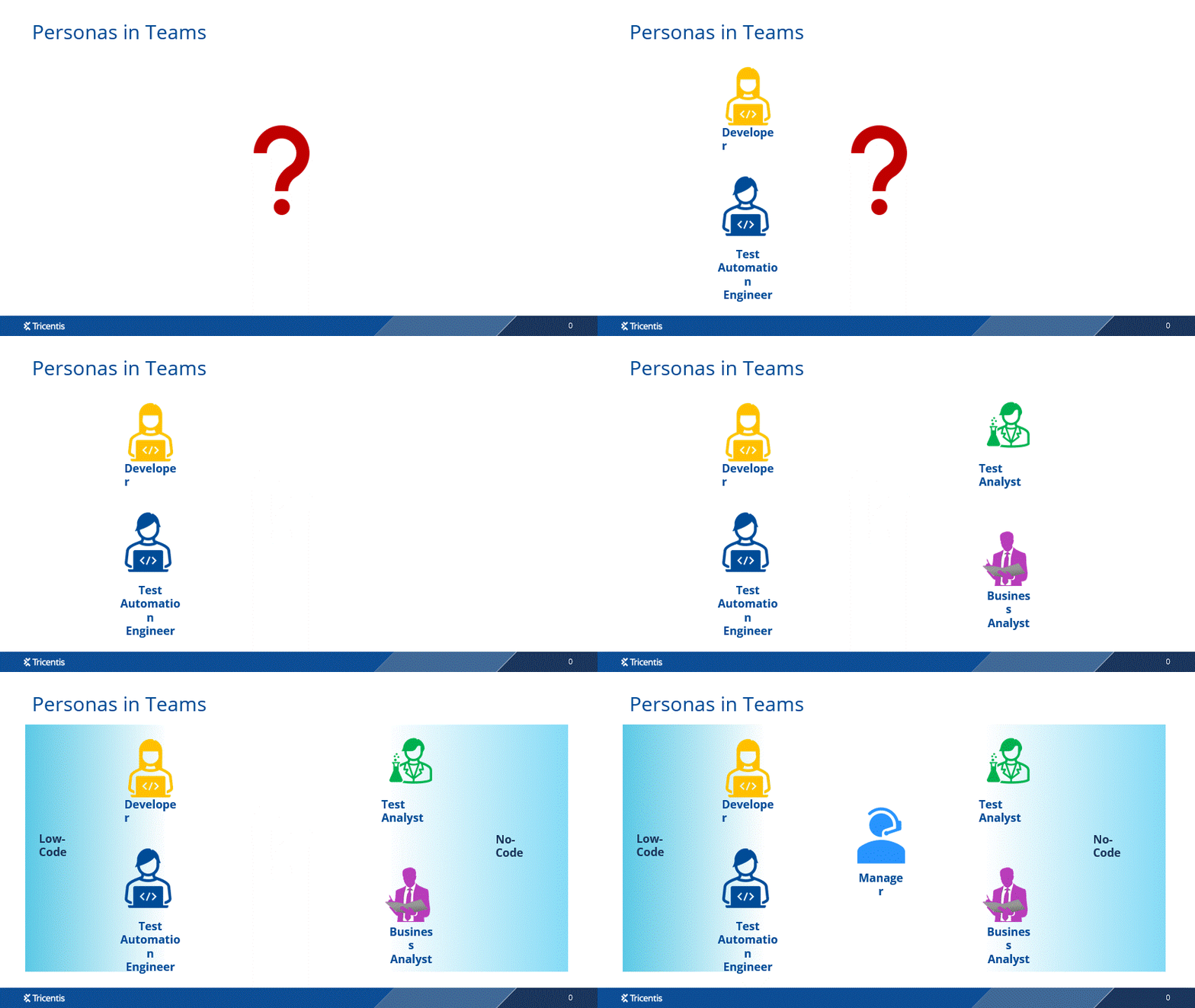
As the barrier of "code" disappears, the benefits of test automation positively impact their daily life. Developers and Test Automation Engineers are more likely to engage with Low-Code test automation – where they can still use their coding expertise significantly – and retain their core skillset. In contrast, Test and Business analysts will likely be more motivated to use no-code solutions.

The manager's role is to ensure that the team delivers the business value – fast and high quality. He doesn't care how their team accomplishes that goal. Does that seem familiar?

Bernhard explained that with Tricentis Tosca, you could Build No-Code, resilient automated tests through a unique approach that separates the automation model from the underlying application. This approach has reduced the maintenance effort required for adapting test automation to frequent changes. Using Tosca, you can cover your value stream by supporting more than 160+ technologies and enterprise applications.

Bernhard ran through other products companies can use to deliver no code, low code automated, and AI testing. But one that stood out in the presentation for me was Testim. Companies use Testim to automate web applications. Whether you are a manual tester, developer, or automation engineer, all users can use Testim to accomplish their goals. It's SaaS-based, Low-code, and AI-powered to help you create tests fast, minimizing test maintenance to keep releases on time.

We finished the day with a roundtable in which we asked a selection of senior DevOps professionals and application leaders this question:

Application leaders: Are speed and quality the key to achieving top business goals?

I manned the white screen and started writing out our table's answers. Early on, an application leader at BT said that quality would always be his priority. He said that quality must be guaranteed to ensure the functioning of his company's highly complex network technology. And the group agreed with this point, so we moved on to our table's question. 

-How do you build teams where quality is the entire team's responsibility?

Our table agreed that the solution to this was two-fold:

> Product-based teams

Ensuring that a team is working towards delivering a specific product ensures that each member is fully invested in completing that product, whether an application, a new release, or even a newly developed piece of software.

> Culture

From culture, we talked about the theme of the day – the war for talent, and how all companies need more software developers, testers, DevOps analysts, engineers, and automation engineers. But as many commented, the talent pool did not seem to grow whilst the demand was.

We talked about the possibility of training. But the consensus was that if I trained one of my team to develop the skills needed to become an automation engineer, his skills would become even more marketable. He is even more likely to be poached by a recruiter and leave my company after I've invested much time and money into him.

Tricentis Sales Executive Cillian Golden presents Tricentis-branded AirPod Pros to an IT Director at an Enterprise Company.


This conundrum highlighted the issue of trust in the organization. It has broken down. And managers and their teams are often at loggerheads. For example, recently, Microsoft commissioned a survey on working from home. 80% of managers thought their employees worked more effectively in the office. But for employees, it was the exact opposite. 80% of employees said that they worked more productively from home.

Under the question of 'Culture', we also discussed siloed organizations being a blocker to quality. That quality requires cooperation (altruism even), and inter-team coordination. And we agreed that innovation also needs those conditions to thrive. Our table decided on the following as our final point before the end of the afternoon:

>Negative – siloed approach, limited collaboration, low trust, not sharing information or resources

>Positive – Product-led, common goals, end-to-end ownership of app delivery value streams

I had no idea the moderator would ask 'the spokesperson' from each of the eight tables to outline what we'd discussed. I was selected to go through the critical points on the microphone, which gave me a kick of adrenaline at 4 pm – even better than a double espresso!